Prisma adventure · English development edition
Ostara Did Not Come
A Prisma folk-horror adventure in which an open investigation changes a ritual escort encounter and the choices available in a pocket-world.
Kirill Sakhin · AI-assisted English translation of the complete Russian Homebrewery manuscript. · Includes GM information and spoilers.
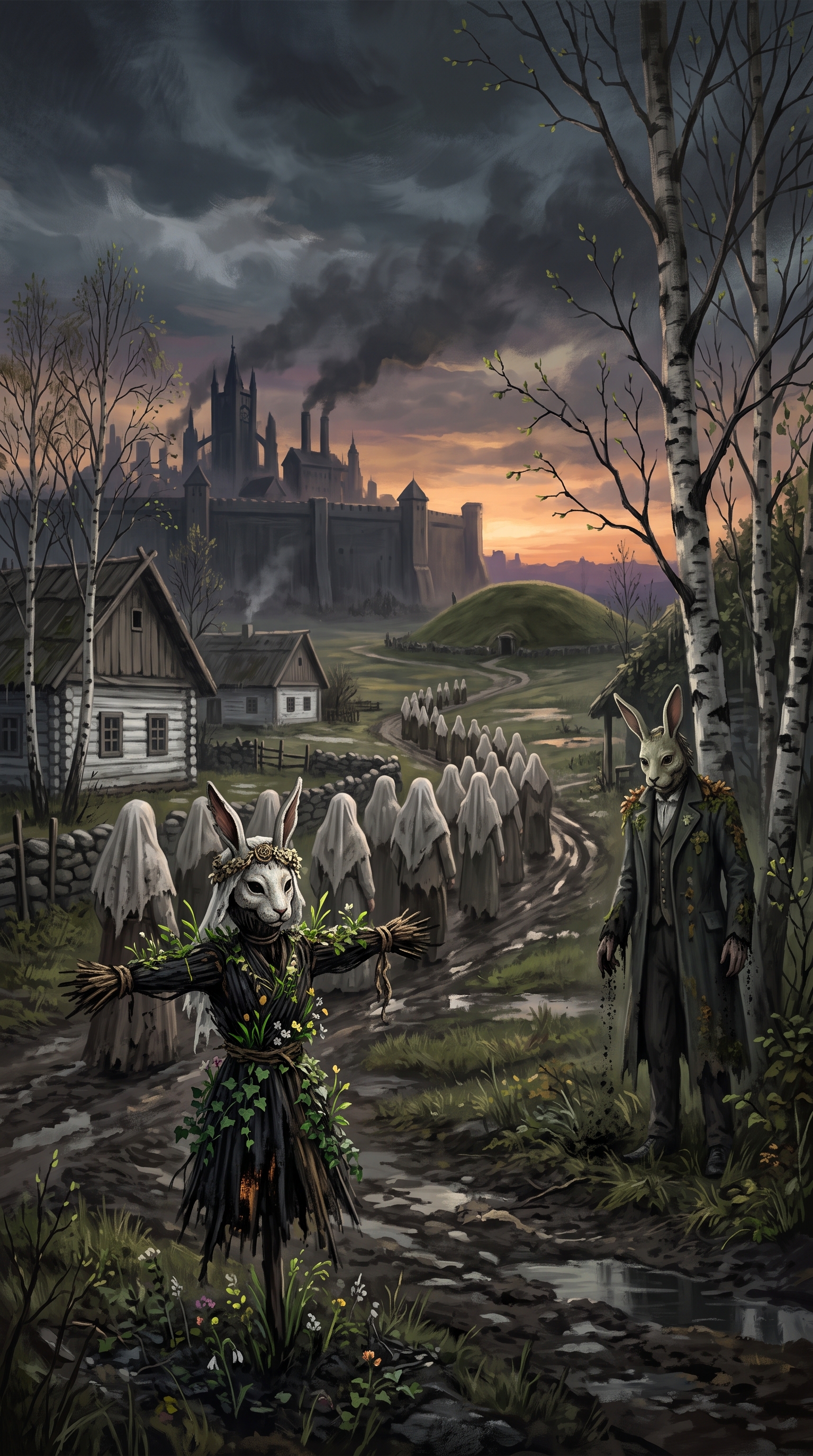
The Bride of the First Furrow
Spring comes only where the dead are named.
An adventure by Kirill Sakhin. Complete English translation of the Russian Homebrewery source dated 26 July 2026, prepared with AI assistance. This is a development reading edition; source mechanics and alternative outcomes are preserved.
Adventure overview
Ostara Did Not Come continues the events of Waxen Hollow. The party has exposed Doctor Ossian Krail, freed the prisoners and returned to Rukfen. Yet Headwoman Mara Vane has publicly placed all the blame on the kobolds, concealing Krail's role and the origin of the candles he made.
A few days later, the village prepares for its annual spring festival, the Rite of the First Furrow. During the ceremony, every person who died in the past year must be named, and the truth of how they left the world must be spoken. Mara repeats her lie about the kobolds.
The rite does not end.
The burned winter effigy appears in Mara's locked bedroom. Villagers begin sleepwalking toward an ancient burial mound. People who vanished thirty-two years ago appear in the village without having aged a day. Behind these events lies an old family secret: Mara herself was promised to an ancient spirit of the land as Ostara, the mortal Bride of Spring. Her sister Nadya tried to take her place. The spirit recognized the substitution and took the entire festive procession into a pocket world, where the guests are still waiting for the true bride.
Now Mara's lie about Krail has repeated that old breach of promise. The spirit has decided that it can wait no longer.
Adventure profile
Level: 2nd; advancement to 3rd on completion.
Party: designed for five characters.
Duration: 2–3 sessions of 3 hours each.
Genre: Slavic folk horror, investigation and moral choice.
Main pillars: investigation, social scenes, ritual conflict, one required combat and one possible combat.
Central themes: the price of another person's promise, survivor's guilt, collective responsibility, and truth as a condition of renewal.
Content and boundaries
The adventure includes disappearances, supernatural captivity, family deception, funerary imagery, and distortions of the body and time. Graphic violence is unnecessary. The missing members of the procession were young adults; children are not subjected to sacrifice or violence.
Connection to Prisma canon
Ostara is not a new goddess in the pantheon. In Rukfen, it is an ancient ritual title for the mortal Bride of Spring, later blended with rural worship of Verdana, goddess of nature, agriculture and growth. Learned priests of Verdana regard the legend as a distorted local custom. They cannot confidently explain the existence of the Green Bridegroom.
In a world where belief and legend sometimes create or strengthen supernatural powers, the King Beneath the Furrows might be an ancient fey spirit, a local guardian of a ley-line, or a being to which generations of belief have given a new form. The final answer is deliberately left open.
Events already played
By default, the module assumes the following facts:
- Vordanne is under quarantine.
- Rukfen had about 150 residents and roughly as many stranded travelers.
- Ten people disappeared over the course of a month.
- The party rescued Nico and two other prisoners.
- Seven known victims died in Krail's production operation.
- Skittrik's kobolds helped abduct people, but acted on Krail's orders.
- The party warned Skittrik and allowed his tribe to leave.
- Mara publicly named the kobolds as the only culprits.
- The party still has Krail's ledgers, medical records, shipping documents for Vordanne, and a letter signed “R.S.”.
Adjusting the death toll
If the number of people rescued or killed differs at your table, change the number of black ribbons and the list of victims. The adventure's structure remains the same.
Beginning the adventure
Events begin two or three days after the party returns from the Waxen Hollow. The characters have had time to rest, reach 2nd level and decide what to do with Krail's evidence, but Vordanne's gates remain closed.
Mara asks the heroes to attend the Rite of the First Furrow as guests of honor: the rescuers' public participation should restore the village's sense of safety.
If the characters openly expose the lie about the kobolds before the rite, the crisis still begins. In that case, treat the Truth about Krail as already revealed, and Mora-in-Bloom begins the final fight without resistance to ordinary weapons. The old pact, the forgotten traveler and Mara's lie about her past remain unresolved.
Background and the truth
The custom of the First Furrow
Every spring, on the first evening after the equinox, the people of Rukfen perform a rite they consider an ordinary village festival.
- They make Mora, an image of winter and the dead, from black straw, dead branches and old clothing.
- Black ribbons bearing the names of everyone who has died since the previous spring are tied to Mora.
- Each dead person's name is spoken aloud, together with the true cause of their death.
- Mora is carried beyond the last furrow and burned beside the ancient burial mound.
- A white spring effigy wearing a wreath of the first herbs is brought back to the village. They call it Ostara.
- In the morning, the headwoman cuts the first furrow in the common field.
The meaning of the rite is expressed in an old saying:
The dead depart with winter. Truth walks before the plow. Only then does the earth know whom it must feed.
Most villagers do not take these words literally. Mara knows more.
The hungry spring
Thirty-two years ago, Rukfen was dying of hunger. A late frost destroyed the seedlings, a reddish film covered the wells, and the livestock stopped producing young. Mara and Nadya Vane's parents found a stone door beneath the old burial mound, mentioned only in the oldest tales.
Beyond the door, the King Beneath the Furrows answered them. He is also called the Green Bridegroom or the White Hare.
He restored the land's fertility. In exchange, the parents promised him the daughter born at dawn on the spring equinox. That daughter was Mara.
Mara knew nothing.
The substituted bride
When Mara came of age, her parents told the truth only to their elder daughter, Nadya. They expected Nadya to help hide Mara or take her away from the village. Nadya chose otherwise: she put on her sister's wreath, covered her face with a white veil, and led the festive procession in her place.
Seventeen young adults set out for the mound. The spirit recognized the substitution at once.
He took Nadya and the others into the Green Reflection, but did not complete the wedding. Three participants were cast back out as messengers. They returned barefoot, with gaps in their memories and the same phrase:
The guests will stay until the bride comes.
Fourteen of the seventeen participants remained in the Reflection.
Why Mara did not go
Mara learned the truth only after the procession vanished. At first, her parents continued to lie; later, her mother confessed on her deathbed.
Mara was young and frightened. She had never agreed to be anyone's bride, did not know whether her arrival would free the missing people, and did not trust a being that had taken innocents as collateral. She did not go.
Over the years, simple fear accumulated persuasive explanations:
- the procession was probably long dead;
- a parent's promise cannot bind a child;
- the spirit cannot be trusted;
- Rukfen needs her;
- revealing the truth would only destroy the missing people's families;
- after so many years, nothing can be put right.
Mara really has become a good headwoman. She knows every family, can distribute supplies, reconcile neighbors and keep the village from panicking. That is precisely what makes it so easy for her to mistake her inaction for duty.
The fading miracle
The old gift has not disappeared, but it is slowly spoiling:
- part of the harvest turns black inside;
- the apple trees bloom twice, but bear fruit only once;
- livestock avoid the field beside the mound;
- once a year, hare tracks the size of a human palm appear outside village homes;
- on the first day of spring, children draw a tall man in a white mask, though nobody teaches them this image.
Rukfen lives on a fading miracle whose price remains unpaid.
The new lie
After Krail is exposed, Mara decides to conceal the true story. Her motives are mixed:
- fear of panic among the travelers;
- concern about another quarantine;
- a desire to preserve trade with Vordanne;
- guilt over the village's purchase of Krail's candles;
- a habit of saving Rukfen at the expense of other people's truth.
At the rite, she names the dead but claims that the kobolds killed them.
To the King Beneath the Furrows, this is no separate, minor lie. It repeats an old pattern: once again, Rukfen seeks renewal by replacing the truth with a convenient story.
The forgotten eighth
The village knows of seven deaths. Yet Krail's medical journal contains an earlier entry: “Subject 0 — Yaros Venn.”
Yaros was a solitary traveler who arrived before Vordanne closed. Nobody expected him, and nobody reported his disappearance. His death never entered the list of the missing.
The rite cannot end until his name is spoken.
The Green Reflection
This is neither a separate great plane nor Verdana's domain. It is a local fold in the Material Plane, created by an ancient ley-line, a rite repeated for generations and the Green Bridegroom's power.
Within it:
- the day is forever suspended just before sunset;
- Rukfen prepares for the festival again and again;
- flowers grow from rotten boards;
- every person casts two shadows;
- music plays in empty houses;
- the fourteen prisoners have not aged physically;
- memories slowly erode with every repetition of the procession.
Nadya keeps her companions from becoming the Bridegroom's retinue entirely. She loves Mara, but is no longer willing to pay endlessly for her fear.
The Bridegroom's true nature
Do not provide a final answer. For mechanical purposes, he is a powerful fey spirit of land and season. Within the world, he might be:
- an ancient servant of Verdana;
- a local guardian of a ley-line;
- a being given a personality by generations of belief;
- a remnant of a cult that predates the temples;
- something merely wearing a familiar mask of fertility.
He does not lie about the pact, but understands justice as exact exchange, rather than freely given consent.
The Truth system
During the investigation, the party can discover five Truths. Track them on a separate sheet. They grant specific advantages in encounters and determine which endings are available.
| No. | Truth | How to discover it |
|---|---|---|
| 1 | Krail and his men organized the killings; the kobolds were intimidated and exploited. | Krail's ledgers, a prisoner's testimony, Skittrik, or the party's public declaration. |
| 2 | Yaros Venn died first and was forgotten because nobody in the village knew him. | The medical journal, a travel token, and Yaros's letter. |
| 3 | Mara was the promised Ostara. | Mara's confession, her mother's letter, or a vision at the old house. |
| 4 | Nadya willingly took Mara's place, but the other members of the procession did not consent to become hostages. | Ilona and Tomash's testimony, or a vision at the crossroads. |
| 5 | The whole village benefited from the gift, so its price cannot be placed on one person. | Comparing old harvests, a sermon about Verdana, or the villagers' collective decision. |
Mechanical use
Each discovered Truth may be spoken aloud once during an encounter with Mora-in-Bloom or the King Beneath the Furrows. This requires no action if the character says no more than one or two sentences.
- Truth 1: Mora loses resistance to Bludgeoning, Piercing and Slashing damage.
- Truth 2: Mora loses Regeneration; in the finale, it becomes possible to complete the remembrance of the dead.
- Truth 3: the Bridegroom cannot conceal Mara or her image with illusions.
- Truth 4: the root servants and prisoners gain Advantage on saving throws against the Bridegroom; some stop fighting.
- Truth 5: makes it possible to rewrite the pact without a human sacrifice.
Cast of characters
Mara Vane
Human, about 50; headwoman of Rukfen.
Mara looks older than her years: gray streaks in her hair, rough working hands, a dark dress without ornaments. In public, she speaks briefly and firmly. Alone, she constantly rubs the wrist where she once wore Nadya's spring bracelet.
Goal: preserve the village and avoid entering the Green Reflection.
Fear: that her sacrifice will be pointless and Nadya will still never return.
Lie: “I knew nothing about the old disappearance.”
Deeper truth: she believes Rukfen cannot do without her, and fears learning that the village can live on without her.
Reactions
- Diplomacy: she gradually admits individual details, but asks the party not to tell the villagers.
- Threats: she shuts down and declares the characters dangerous outsiders.
- Evidence: she moves from denial to excuses.
- Compassion: mentioning Nadya reaches her more strongly than accusations.
- Public exposure: first rage, then cold silence; she may nevertheless support the party in the finale.
Voice
“You saved people. I save the village. Sometimes those are different jobs.”
“They promised me away before I could speak. Don't you dare call that my oath.”
Nadya Vane
Human, appears 22; Mara's elder sister.
A tall woman in a faded white dress, wearing a wreath that has remained fresh for decades. Her calm became a weapon long ago. She neither cries nor begs to be rescued.
Goal: free the procession without handing Mara over to a being she never agreed to belong to.
Fear: that the prisoners' memories will vanish before the door opens.
Attitude toward Mara: love, anger and exhaustion at once.
Secret: several years ago, measured in subjective time, she could have left alone, but stayed for the others.
Voice
“I chose to save you. They never chose to save you alongside me.”
“Don't come here out of guilt. Guilt makes a poor bride and an even worse sister.”
Ilona Drask
Human, about 55; herbalist and one of the three who returned.
A quiet woman with fingers stained by herb juices. She did not speak for seven years after her return. She draws the same green door on walls, boards and eggshells.
Knows: the route into the Reflection, the Bridegroom's appearance, and Nadya's role.
Conceals: she helped Nadya put on the veil and understood what was happening.
Why she stayed silent: she feared the village would force Mara to follow.
Tomash Revek
Human, about 57; cooper, returned to Rukfen because of the quarantine.
A harsh, hard-drinking man who left the village long ago. His right palm has no lines: the skin is as smooth as a wax doll's.
Knows: the Bridegroom recognized the substitution immediately.
Conceals: he was the first to run and abandoned the others.
False account: the procession followed the spirit willingly.
Vesna Dobromira
Human, about 80; former midwife and keeper of local customs.
She did not take part in the old procession, but knows how the rite works. She scolds city priests, Krail, Mara and the characters with roughly equal vigor.
Role: explain the meaning of the First Furrow without handing over a ready-made solution.
Position: a promise made on an infant's behalf has no moral force, but the village cannot simply declare the gift it received to be free.
“The earth doesn't read contracts. It remembers who ate its bread.”
The King Beneath the Furrows
A tall figure in an old wedding coat. In place of a face, he wears a white hare mask; thin birch branches grow behind its long ears. Black earth constantly spills from his sleeves.
Goal: receive the promised Ostara or an equivalent, truthful repayment.
He is not: a demon, a god of the pantheon, or a secret servant of the Abyss.
Defining trait: he is patient and certain that humanity broke the order of things.
“You call it cruelty because you remember only the price. I remember the gift.”
“I was promised spring. They sent me love in someone else's dress.”
Act I: The rite that would not burn
The spring festival
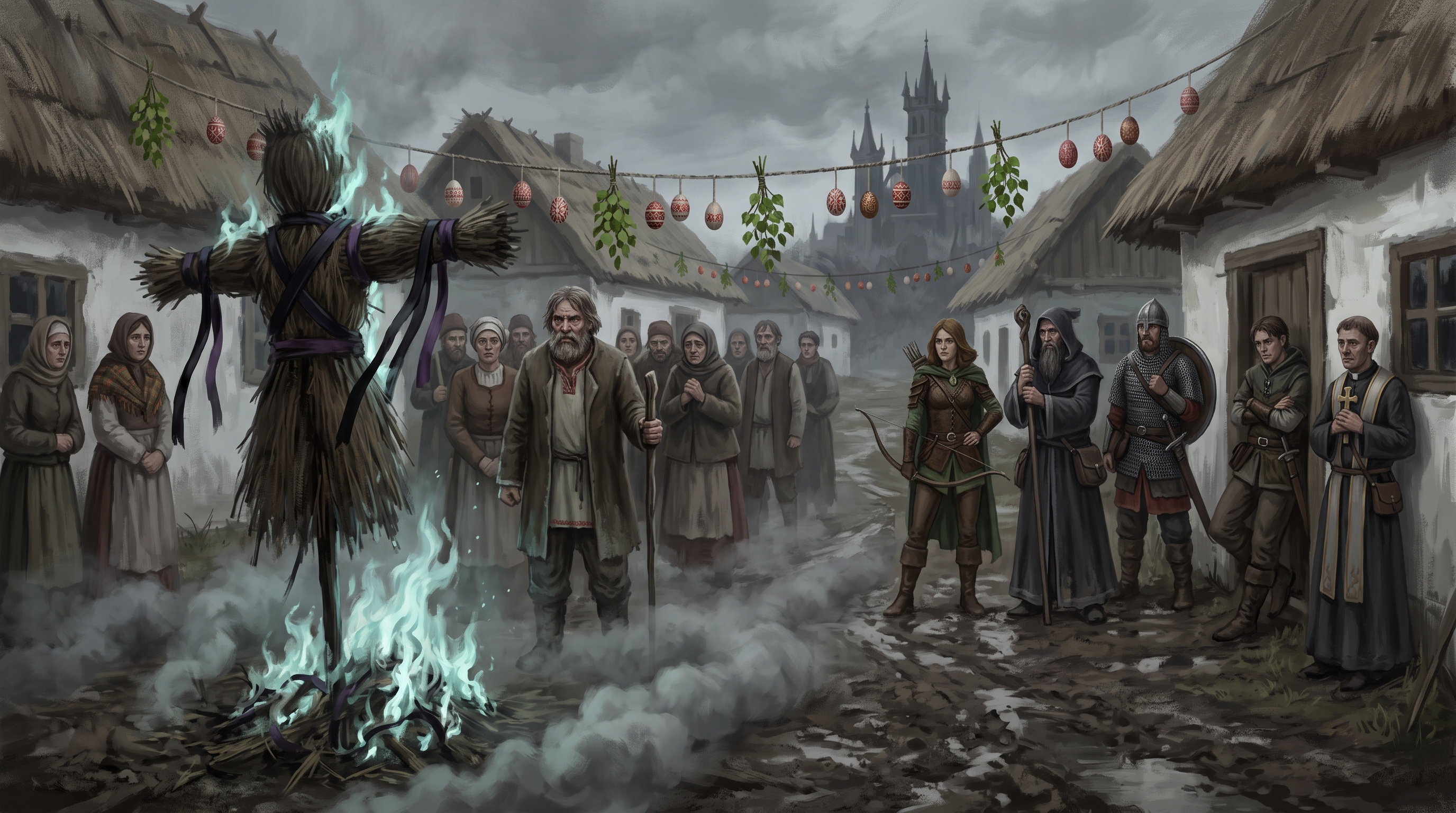
Rukfen's square is decorated with green ribbons, painted eggs and young birch branches. A black straw effigy of Mora stands at its edge, the dead people's ribbons tied to her arms.
The party stands beside Mara as guests of honor and the village's rescuers.
The smell of wet earth mingles with smoke from hearths. Painted eggs and green and white ribbons sway on ropes strung between the houses. Children run around a straw woman in a black headscarf, while the adults regard her with a gravity that seems out of place at an ordinary festival.
Beyond the last rooftops, Vordanne lies gray. Its gates are still closed, its towers silent, and its quarantine banners do not stir even in the wind.
Introducing the rite
Vesna Dobromira briefly explains the custom to the guests. Mara then names the seven known dead, one by one, and says:
“They were taken by the forest kobolds, who repaid our kindness with deceit.”
If the characters object, let them speak. The crowd's reaction depends on the evidence:
- Without evidence: most people believe the heroes are defending monsters.
- With Krail's ledgers or a prisoner: some villagers believe them, but Mara asks them to finish the argument after the ceremony.
- With Skittrik: the crowd becomes dangerous; a DC 13 Charisma (Persuasion or Intimidation) check is required to prevent violence.
Whatever the result, Mora is carried to the mound.
The wrong fire
The torch touches the straw. Flame runs over the black dress, but gives off no warmth. The smoke does not rise. It crawls along the ground toward the village, as though searching for a way back.
When the fire reaches the effigy's head, one short knock sounds from within. Then a second. Then seven knocks at once.
The following occurs:
- all ordinary fires go out;
- enchanted items briefly dim;
- Mora burns down to a black frame;
- Ostara's spring effigy vanishes from its place;
- seventeen villagers turn toward the mound and take a single step in its direction;
- Mara drops to her knees and, for the first time, speaks the name “Nadya.”
A few seconds later, everything stops.
A guest in the bedroom
That night, Mara summons the characters to her house. The bedroom door was locked from within, the windows closed. An intact Mora-in-Bloom stands inside.
The straw woman stands beside the bed, though you saw her burn with your own eyes. Fresh green shoots grow from her charred ribs. Seven black ribbons hang from one wrist; fourteen green ribbons from the other. Her face is covered by a white mask, its hare's mouth drawn in children's paint.
Several voices speak at once beneath the mask:
“Name us rightly.”
Then one young woman's voice adds:
“The guests are tired of waiting.”
Examining the room
| Check | Result |
|---|---|
| DC 10 Wisdom (Perception) | Damp earth lies beneath the effigy, containing seeds not found around Rukfen. |
| DC 12 Intelligence (Nature or Arcana) | The plant is alive, but does not feed on light; it is sustained by memory and ley resonance. |
| DC 12 Intelligence (Investigation) | There are fourteen green ribbons; this is not the number of recent victims. |
| DC 11 Wisdom (Insight) | Mara recognizes the wreath on Mora's head and deliberately stays silent. |
| Detection magic | Reveals a mixture of fey and nature auras, with a faint necromantic aura of memory. |
If the facts corner Mara, she admits only: “Nadya was my sister. She disappeared during an old festival.”
The first sleepwalker
While the party discusses the discovery, a villager begins sleepwalking toward the fields. This could be Jessa, Tomash or another familiar NPC. They carry a painted egg bearing the name of one of the dead.
To stop the walker without harming them:
- wake them with an action and a DC 10 Wisdom (Medicine) check;
- block their path and succeed on a DC 11 Strength saving throw against roots that suddenly sprout;
- use suitable magic;
- follow them without intervening.
The walker leads to the old crossroads, where a second egg lies on the ground. It bears an unfamiliar name: Yaros Venn.
Ending the act
By morning, Mora has vanished from the house. The outline of a green door remains on the wall.
Mara asks the party to “solve the problem before the next sunset” and offers 50 GP from the village treasury. She still asks them not to tell the villagers about Nadya.
Act II: Rukfen remembers
In this act, the characters freely choose which investigation locations to visit. To move on, they need only uncover the three key facts: Yaros's name, the existence of the old procession, and Mara's connection to the title of Ostara.
Investigation map
| Location | Main clue | Additional benefit |
|---|---|---|
| Village shrine | The true wording of the rite | Information about Verdana and the nature of the local cult |
| Vesna Dobromira's house | The list of the dead and an old wreath | A safe protective rite against sleep |
| Krail's shop | The entry about Yaros Venn | Yaros's letter and what remains of his belongings |
| Ilona Drask's house | Drawings of the Green Door | A way to enter the Reflection |
| The inn / Tomash | The Bridegroom's words | Testimony about the substitution |
| The old Vane house | The mother's confession | The Truth about Mara |
| The mound and crossroads | Traces of the old procession | A vision of the past |
Location 1: The village shrine
The small building is dedicated to Verdana, although its local images are far older than the official symbols. On one wall, a faded mural depicts a woman holding grain and a skull.
Someone has recently scraped away the lines beneath the fresco.
Clues
- A DC 11 Intelligence (Investigation) check reveals the surviving words: “not only the name, but the journey's end.”
- A DC 12 Wisdom (Religion) check shows that the rite combines worship of Verdana with an older tradition.
- Beneath a layer of limewash lies the phrase: “Ostara is not the one to whom they pray. Ostara is the one they lead.”
Priest or keeper
If an NPC is needed, use Father Savel, an elderly village servant of Verdana. He does not know Mara's secret, but considers the local legend a dangerous heresy.
“Verdana does not demand brides. The earth accepts labor, blood from a cut, and the ashes of the dead, but not people. If someone here demands a person, that is not the goddess.”
This is an important moral position, but not conclusive evidence of the Bridegroom's nature.
Location 2: Vesna Dobromira's house
The house is filled with dried herbs, threads and dozens of painted eggs. Vesna quickly realizes that the old debt has returned.
She gives the party:
- a list of the seventeen procession participants;
- Nadya's old wreath;
- a pouch of salt and seeds to protect against sleep;
- advice to find the three who returned.
Nadya's wreath
When it is held against Mora or a green door, the bearer sees a brief scene: a girl removes a bracelet from little Mara and says, “You'll wake up tomorrow. I'll try to, too.”
Protective circle
A character who sleeps in a circle of salt and seeds has Advantage on saving throws against the Bridegroom's Sleep Call until the next dawn.
Location 3: Krail's shop
The shop is sealed or guarded by two villagers. It no longer operates as a shop. There should be no new dungeon here: the scene centers on finding documents and the emotional aftermath of the previous adventure.
Discoveries
- The medical journal contains “Subject 0 — Yaros Venn.”
- A drawer contains a travel token bearing Yaros's name.
- An unsent letter is hidden behind a cupboard.
- Krail noted that “no one will report” Yaros missing.
- One formula uses herbs gathered by the mound, but this is a coincidence, not the cause of the old curse.
This reveals Truth 2.
The letter is written unevenly, as though the writer rested it on his knee:
“Dear Ella. The gates are still closed, so I'll stay in Rukfen a few more days. It's dull here, but safe. When I return, I'll tell you why the locals paint their eggs green…”
Location 4: Ilona Drask's house
Every wall is covered with images of the same door: green boards, a hare-shaped handle, sunset shining through the cracks.
Ilona barely answers direct questions. She invites the characters to paint an egg. If someone writes the name of a person they fear losing, Ilona begins to speak.
Her account
- Nadya put on Mara's wreath.
- Ilona helped hide her face beneath the veil.
- A tall man in a hare mask appeared beside the mound.
- He looked at Nadya and said, “You smell of love, but you are not spring.”
- Three people ran; Ilona woke in a field.
This reveals part of Truth 4.
Opening the door
Ilona knows the conditions:
- the door appears at sunset at the forest crossroads;
- Nadya's wreath must be brought;
- at least one forgotten dead person must be named;
- nobody may enter under another person's name.
Location 5: Tomash Revek
Tomash is among the travelers in the crowded tavern. At first, he denies having joined the procession.
What gives him away
- He knows an old song that people stopped singing after the disappearance.
- His smooth palm turns green near Nadya's wreath.
- He breaks his mug when he hears the words “White Hare.”
A successful DC 12 Charisma (Persuasion or Intimidation) check, help in the form of alcohol, or a character's honest confession persuades him to tell the truth.
He ran first. He heard the Bridegroom promise to hold the guests until Mara came.
“I thought they were following me. Then I realized nobody was even looking after me. I was too small for their tragedy.”
This reveals Truth 4 in full.
Location 6: The old Vane house
The house is abandoned and used for storage. A tin box containing Mara's mother's letter is hidden in the nursery wall.
The characters can find the box through:
- a DC 12 Intelligence (Investigation) check;
- a memory in Nadya's wreath;
- a hint from Vesna;
- Mara's confession after a persuasive scene.
The mother's letter
See the handout in the appendix. It confirms that Mara was promised at birth and knew nothing about it.
This reveals Truth 3.
Location 7: The mound and forest crossroads
Spring has arrived early at the mound: green grass is surrounded by snow that has yet to melt. A woman holding grain in one hand and a skull in the other is carved into the stone.
Hazard: An echo of the procession
On their first approach, each character makes a DC 11 Wisdom saving throw. On a failure, for 1 minute they see the old procession in place of their allies. This does not remove the character from play, but imposes Disadvantage on their first check in the scene.
A vision of the past
Touching the stone, using Nadya's wreath, or casting a divination spell triggers an interactive vision.
The characters find themselves among the procession, but nobody in the past sees them directly. Each can choose whom to follow:
- Nadya: reveals the willing substitution.
- Ilona: reveals the preparation of the veil.
- Tomash: reveals the three survivors' flight.
- Mara's parents: reveals that Mara stayed at home and knew nothing of the rite.
- The Bridegroom: reveals that he did not accept Nadya as his bride.
Each chosen path automatically grants the corresponding clue. If the party splits up, they can witness several perspectives at once.
Vision mechanics
The visions are not true time travel. The characters cannot change events, but can investigate what the witnesses failed to notice.
Each vision contains:
- An observed scene. The GM reads the description.
- A free choice. Each character says whom or what they follow.
- One check when risk is involved. Failure brings a complication, but does not withhold the clue.
- A personal echo. One character sees an image connected to their own history.
Possible personal echoes
Use no more than one per character throughout the adventure.
Laura Silverwave
For a moment, Nadya's white veil turns silver. Laura's patron senses an old oath, but does not recognize it as just.
“The bond exists. Consent was never given.”
Alrik Voss
He sees his father among the people of the past, though he knows Arden could not have been here. The image says:
“People love verdicts that require them never to hear the accused.”
This is not a real message from Arden, but the Green Reflection's way of exploiting the observer's guilt.
Grimbald Noctus
Radek falls silent, then recognizes the military logic of hostages:
“He holds fourteen to get one. An officer's arithmetic. I hate it when spirits learn from people.”
Valtiriy Brinnikh
He sees the ley-line as a green arc closing around the mound. This is not the influence of the Abyss. The Green Reflection is a local fold in coordinates; it can be torn apart, but the land will bear the consequences.
Hanas
Choose an echo suited to his patron and history. By default, he hears knocking deep beneath the stone: someone is beating the procession's rhythm from inside the mound.
Investigation complications
After every second location visited, choose a complication or roll a d6.
| d6 | Complication |
|---|---|
| 1 | Three more villagers begin sleepwalking. |
| 2 | Green handprints appear on every door in the village. |
| 3 | The travelers demand that Mara and the heroes be expelled. |
| 4 | A group of villagers gathers to hunt the kobolds. |
| 5 | One survivor vanishes through a painted door. |
| 6 | A silent green flash comes from Vordanne; every magical light trembles. |
Skittrik's return
If the party parted on good terms with Skittrik, he returns in secret. The kobolds have seen green lights by the quarry and fear the village will blame them again.
Skittrik can:
- confirm that Krail directed the abductions;
- provide Truth 1;
- reveal a hidden personal possession of Yaros's;
- help lead the kobolds past the enraged villagers.
If Skittrik appears in public, the party must protect him from the crowd. This is a social encounter, not a required fight.
Act III: The Procession of the Equal Night
This act is one combat escort encounter with several phases, rather than a succession of separate checks. The characters act in normal initiative order, use the standard D&D 2024 actions, and simultaneously deal with battlefield objectives: opening the route, intercepting abductors, directing the walkers and completing the remembrance of the dead.
Rukfen's doors open one after another. People emerge barefoot, in nightshirts, with white cloth over their faces. They carry green candles and painted eggs.
Mara Vane walks at their head. She is not asleep. She knows where she is going, but her feet keep moving of their own accord.
“I won't go,” she whispers. “I won't go. I won't go.”
The characters' objective
The characters must escort the procession to the old mound, keep the Bridegroom from taking new guests, and complete a true remembrance there. Killing the enemies does not, by itself, end the encounter.
The encounter has four phases:
| Phase | Objective |
|---|---|
| I. The thorn gate | Destroy or deactivate three Thorn Hearts before the procession enters the wall of roots. |
| II. The Rag Maidens | Break the green ribbons and keep the Maidens from leading walkers away. |
| III. The ice of dead reflections | Direct three groups along changing safe lanes and neutralize dangerous stretches. |
| IV. Mora-in-Bloom | Hold Mora at bay, evade the furrows and complete three Remembrance Knots. |
Initiative and the procession's turn
Roll initiative once at the beginning of the act. Keep it until the Green Door opens.
The procession acts on initiative 0. On its turn, after all creatures in the round, the GM performs four steps:
- Resolve the current phase's previously signaled hazards.
- Move each group that has not been held back 15 feet toward the mound.
- Resolve active green ribbons and other threats to the groups.
- Signal the next round's hazards.
The first hazard of each phase is signaled as soon as the phase begins, but resolves only on the procession's next turn. The players always have a full round to respond.
Walker tokens
Do not place seventeen individual miniatures. Use three tokens:
| Group | Members |
|---|---|
| Front | Mara and four villagers |
| Middle | Six villagers and travelers |
| Rear | Six villagers and travelers |
Mara moves with the Front group, but cannot be selected as a lost walker during this act.
Green Mark
Each group begins without a mark.
- The first time a group is caught by an uncountered mechanic, place a Green Mark beside it.
- If a group with a Green Mark is caught by a mechanic again, one walker is transported into the Green Reflection, and the mark is removed.
- A lost walker does not die. They appear in the next act and can be rescued.
- A group cannot have more than one Green Mark.
A visible failure counter
The Green Mark is a warning, not an immediate punishment. The players can see which group needs help and correct one mistake before someone is abducted.
Special character actions
These actions provide additional options for a normal action.
Direct a Group
Action. A character within 5 feet of a group moves it up to 10 feet sideways or backward, or holds it back until the procession's next turn. A group held back does not move on that turn; the delay then ends. Each group can be held back no more than once per phase.
Intercept a Hazard
Reaction. When a group within 10 feet would receive a Green Mark or lose a walker, a character can move 5 feet toward it without provoking Opportunity Attacks and take the mechanic upon themselves. The group avoids the consequence. The character makes the saving throw specified by the mechanic; on a failure, they suffer its damage and condition.
Work on a Mechanism
Thorn Hearts, green ribbons, ice and Remembrance Knots use the normal Attack, Magic, Study and Utilize actions. A suitable spell or a good idea can replace a check or grant Advantage.
Help
The Help action works normally. The character must be near the creature, object or group they are helping.
Phase I: The thorn gate
Beside the last house, the earth swells with dark veins. Three knots of roots burst out: one in the middle of the road, two at its edges. A wall of black thorn instantly weaves itself between them.
A green heart pulses within each knot. The procession does not slow down.
Phase objective
Deactivate three Thorn Hearts by the end of the procession's second turn. The party starts 30 feet from the gate, beside the walker groups.
Thorn Heart
Small magical object
- AC 12; HP 7
- Immunity to Psychic and Poison damage.
- Takes an additional 3 damage from each separate source of Fire damage.
A Heart can be deactivated in any of the following ways:
- reduce its HP to 0;
- use an action to make a DC 12 Intelligence (Arcana or Nature) check;
- use an action with suitable tools to make a DC 11 check;
- use a spell that convincingly tears apart, restrains or withers the roots.
On a failed check, the roots seize the character: they have the Grappled condition until the end of their next turn; escape DC 11.
Mechanic: Thorn Lines
At the start of the phase, mark a line 20 feet long and 5 feet wide extending from each active Heart. On the procession's next turn, roots erupt along the lines.
A creature in a line makes a DC 11 Dexterity saving throw.
- Failure: 1d4 Piercing damage and the Grappled condition until the end of the creature's next turn.
- Success: half damage, with no condition.
If a line passes through a walker group, the group receives a Green Mark. A character can use the Intercept a Hazard reaction.
After the lines resolve, each active Heart signals a new line.
End of the phase
The phase ends when all three Hearts are deactivated or the procession finishes its second turn.
- If all Hearts are deactivated, the wall folds into an arch of white branches. There are no consequences.
- If one Heart remains, the Front group receives a Green Mark.
- If two or three Hearts remain, the Front and Middle groups each receive a Green Mark.
The gate then opens regardless: the Bridegroom needs his guests alive.
What the players should understand
This is not a check to “break through the wall.” Three visible sources sustain the barrier, danger lines are signaled in advance, and the procession keeps moving. Some characters break the Hearts while others direct and protect the people.
Phase II: The Rag Maidens
Beyond the gate stand three young women in old festival dresses. Their faces are sewn from white cloth. Each raises a green ribbon, which reaches of its own accord toward one of the walker groups.
Place three Rag Maidens, one opposite each group. The phase lasts two procession turns, or until every Maiden is destroyed or has become nonhostile.
Mechanic: Green Ribbon
As a Bonus Action, a Maiden can bind herself to a group within 30 feet. Place a visible ribbon marker between them.
The ribbon is an object:
- AC 10; HP 5;
- immunity to Psychic and Poison damage;
- a character beside the ribbon can use the Utilize action to cut or tear it free without a check if they have a suitable tool;
- any forced movement of the Maiden greater than 10 feet also breaks the ribbon.
On the procession's turn, each surviving ribbon pulls tight. The linked group receives a Green Mark. If it already had a mark, the Maiden leads one walker into the Green Reflection, the mark is removed, and the Maiden vanishes.
A character can step into the ribbon's path with the Intercept a Hazard reaction. They make a DC 11 Strength saving throw.
- Success: the ribbon breaks.
- Failure: the ribbon breaks, but the character takes 1d4 Slashing damage and is Grappled by the Maiden until the end of her next turn.
Maiden behavior
The Maidens do not try to kill the characters. They defend their ribbons, use Green Thread against those running toward linked groups, and attack only creatures that interfere with them.
If the Truth about Nadya's willing sacrifice is spoken aloud, each Maiden makes a DC 12 Wisdom saving throw. On a failure, she breaks her ribbon and leaves combat; on a success, she cannot create a ribbon until the end of her next turn.
End of the phase
After the procession's second turn, the groups leave the birch avenue. All unlinked Maidens remain behind. Any ribbon that has not resolved by this point immediately breaks without effect.
Phase III: The ice of dead reflections
The stream has spread into a broad stretch of smooth ice. Beneath its transparent crust, there is no water. People in burial clothes walk there, slowly, in the opposite direction. Each wears the face of the person looking down from above.
Three crossing lanes lie before you. The ice in one whitens and hardens. Black cracks appear in another. Beneath the third, the reflections' hands rise.
Battlefield
Divide the crossing into three parallel lanes, each 10 feet wide: left, middle and right. Each group occupies a separate lane. Two groups cannot safely occupy one lane: if they do so on the procession's turn, both receive a Green Mark because of the crush and cracking ice.
The phase lasts two procession turns. The ice is Difficult Terrain for the characters. Walker groups ignore this slowdown and keep moving.
Lane states
At the beginning of each round, the GM clearly signals each lane's state. Use these two patterns:
| Round | Left | Middle | Right |
|---|---|---|---|
| 1 | Safe | Cracked | Haunted |
| 2 | Haunted | Safe | Cracked |
The characters can use the Direct a Group action to move a group into another lane, but only one group fits safely in each lane. Therefore, one of the two dangerous lanes must be neutralized every round.
Cracked lane
The ice breaks on the procession's turn.
- A group in the lane receives a Green Mark.
- A character in the lane makes a DC 11 Dexterity saving throw. On a failure, they take 1d4 Cold damage and fall Prone.
Neutralization: use an action to make a DC 11 Strength (Athletics), Wisdom (Survival), or Utilize check with suitable equipment. Boards, rope and a pole grant Advantage. A spell that creates a bridge or reinforces the ice automatically neutralizes the lane for the round.
Haunted lane
A large reflection appears beneath the ice, repeating the nearest character's movements a second late.
Dead Reflection: AC 12, HP 8; immunity to Psychic and Poison damage. It can be attacked through the ice, banished with an action and a DC 12 Intelligence (Arcana or Religion) check, or dispersed by a suitable spell. Radiant damage deals an additional 3 damage to it.
If the reflection remains on the procession's turn:
- a group in the lane receives a Green Mark;
- a character in the lane makes a DC 11 Wisdom saving throw. On a failure, hands beneath the ice seize them: they have the Grappled condition; escape DC 11.
Safe lane
It produces no effect. White flowers can be seen frozen within the ice.
End of the phase
After the procession's second turn, every group reaches the far bank. Record the number of lost walkers and retain any remaining Green Marks: they matter in the next phase.
The phase's arcade logic
Every round, one lane is safe and two need an answer. The players see the pattern in advance and must divide their efforts between the dangerous lanes. Moving groups allows them to protect walkers who are already marked, or assign each group a mechanic that nearby characters are best equipped to handle, but does not eliminate the danger by itself. This is a spatial problem, not three identical escort rolls.
Phase IV: Mora-in-Bloom
Beyond the stream, the procession kneels before the mound. A tall figure of black straw stands between the people and the green door. Three ribbons hang from her arms: black, white and colorless.
“You can burn me,” she says in the voices of the dead. “But while the lie still stands, I will rise again.”
Phase objective
Complete three Remembrance Knots. Damage to Mora creates safe openings, but is not a victory condition on its own.
Place three ritual points around the mound, 20–30 feet apart:
| Knot | Required truth | What it disables |
|---|---|---|
| Black Ribbon | Krail and his men killed villagers; the kobolds were exploited. | Mora loses resistance to nonmagical Bludgeoning, Piercing and Slashing damage. |
| Empty Egg | Yaros Venn's name, and acknowledgment of the unnamed dead person. | Mora's Regeneration ends; remove one existing Green Mark from a chosen group. |
| White Veil | Mara's confession about the old promise and Nadya's substitution. | The Black Furrow mechanic ends. |
Completing a Knot
Each Knot requires two actions, and no more than one action can be invested in a particular Knot in a single round.
- Prepare the memory. Utilize, Study or Magic: attach an object, lay out names, remove an old ribbon or draw a sign.
- Speak the truth. Influence, Study or Magic: speak the truth aloud and make it heard.
If the party has found the corresponding evidence and states the truth correctly, no check is required. If some information is missing, use a suitable DC 12 check. Failure does not remove accumulated progress, but the action is spent.
When a Knot is completed, Mora takes 8 Psychic damage that ignores resistances, and loses the specified ability. When all three Knots are complete, Mora immediately falls apart and opens the Green Door.
Mechanic: Woven Winter
Until all three Knots are completed, Mora cannot be permanently destroyed.
If she drops to 0 HP, she falls apart until the procession's next turn. While she is in pieces, she takes no actions and creates no Black Furrow. On the procession's next turn, she reforms with 15 HP beside an unfinished Knot.
Damage therefore remains useful: the characters can bring the boss down and gain a round to work on the Knots.
Mechanic: Stagger Mora
If Mora takes a total of 10 or more damage between two procession turns, she does not create a new Black Furrow on the procession's next turn. Reset the counter after each procession turn.
Mechanic: Black Furrow
At the start of the phase, mark two lines on the ground, each 30 feet long and 5 feet wide. Roots erupt from them on the procession's next turn.
A creature in a line makes a DC 11 Dexterity saving throw.
- Failure: 1d6 Bludgeoning damage; the creature falls Prone and is pushed 5 feet away from the nearest Knot.
- Success: half damage, without falling or moving.
After the furrows resolve, Mora signals two new lines if this mechanic remains active and has not been canceled by Staggering.
Pressure on the procession
If nobody invests an action in any Remembrance Knot during a round, one group with a Green Mark loses a walker on the procession's next turn. If no groups are marked, the Middle group receives a Green Mark.
Beginning with the phase's fifth round, one walker is transported into the Green Reflection on every procession turn, regardless of marks. This is a soft enrage: the combat does not end in instant defeat, but the price of delay rises.
Mora's tactics
Mora does not pursue characters at 0 HP. She tries to:
- push heroes away from the Knots;
- attack the character who has just advanced a Knot;
- stand between a group and its nearest defender;
- use Roots of Memory to reposition.
For this version, remove her Multiattack. On her turn, she makes one Thorn Hand attack or uses Name Me if available.
Ending the act
Once Mora falls apart, all walkers are freed from the Sleep Call. Green Marks disappear. Lost villagers remain in the Green Reflection and will be found in the next act.
| Walkers lost | Consequence in the Green Reflection |
|---|---|
| 0 | Nadya meets the party as potential rescuers; Advantage on the first Influence check against her. |
| 1–2 | The lost walkers are at the wedding table, but still retain their identities. |
| 3–4 | One lost walker becomes a Root Guest with 9 HP. |
| 5+ | Two lost walkers become Root Guests; the King Beneath the Furrows gains 5 Temporary HP. |
Balance for five 2nd-level characters
Direct damage in the first three phases should remain low: usually 1d4, with movement or Grappled effects. The main stakes are abducted walkers, rather than draining the party's HP. Mora uses one attack per turn. If the characters enter the final phase badly depleted, reduce her HP to 32 and do not introduce the soft enrage until the sixth round.
GM reference: The four phases
| Phase | Timer | Telegraph | What the players do | Cost of failure |
|---|---|---|---|---|
| Thorn gate | 2 procession turns | Lines from three Hearts | Break Hearts, direct groups, intercept roots | Marks for the Front/Middle groups |
| Rag Maidens | 2 procession turns | Visible green ribbons | Cut ribbons, move Maidens, protect groups | A mark or an abducted walker |
| Ice | 2 procession turns | The states of three lanes | Move one group and neutralize the second dangerous lane | A mark or an abducted walker |
| Mora | At least 2, usually 3–4 rounds | Furrows and three Knots | Hold the boss at bay, create an opening with damage, complete 6 Knot actions | Abductions and a harder following act |
Act IV: The Green Reflection
This act concludes the story of Mara, Nadya and the old procession. Its climax begins as a negotiation, may become a short raid-style hostage rescue, and develops into a full fight against the Green Bridegroom only if the party chooses.
The act's central principle
The characters do not have to fight the Bridegroom. If Mara willingly fulfills the promise, or the party offers a convincing New Word of its own, the finale can end without combat. The Green Bonds phase begins only when negotiations break down, Mara refuses to go, the party resorts to violence, or the Bridegroom decides to use the procession as collateral again.
First impression
Beyond the green door lies Rukfen, and something that is not Rukfen.
The sun hangs motionless above the rooftops in the last golden hour. Flowers grow from rotten walls, festival ribbons stretch between empty houses, and music comes from every direction at once. Fourteen young people stand in the square, wearing clothes from thirty-two years ago.
Each casts two shadows.
Beside the well, a woman in a white wreath lifts her head. She looks at Mara, not the heroes.
“At last,” says Nadya Vane. “Or is it someone else again?”
Laws of the Green Reflection
- One hour inside the Reflection equals roughly ten minutes outside.
- Food and water look fresh, but turn to earth in the mouth.
- Any road out of the village returns the traveler from the opposite side.
- Teleportation and other magical movement work only within the Reflection and cannot be used to leave it.
- Prisoners do not age physically, but each repetition of the festival erases some of their memories.
- A willing step has greater power here than compulsion. The Bridegroom cannot complete the old promise unless Mara herself crosses the threshold of the wedding table.
- Truth spoken by someone who accepts its consequences can change the Reflection itself.
The sisters' reunion
Play out Mara and Nadya's conversation before introducing the Bridegroom. Nadya wants an answer, rather than an excuse: why did Mara not come after learning the truth?
Possible replies from Nadya
- “I didn't know.” “Later, you did.”
- “I was afraid.” “The truth at last.”
- “The village needed me.” “We were the village, too.”
- “I promised him nothing.” “And we never agreed to be collateral.”
- “I thought you were dead.” “You hoped we were dead. It was easier that way.”
Nadya does not demand that Mara sacrifice herself immediately. For thirty-two years, she has tried to find another price, but any substitution would repeat their parents' crime: making one person pay for everyone again.
What Nadya knows
Nadya can explain three rules:
- The Bridegroom cannot force Mara to become Ostara.
- The old procession is collateral holding an unfinished promise in place.
- The Bridegroom understands truth, a freely offered price and equivalence, but not humanity's idea of fair consent.
Nadya does not yet know what exactly can replace a single human life. If the party has already discovered Truth 5 and independently proposes a shared obligation for Rukfen, she immediately understands and supports the idea.
The house without doors and a Short Rest
The house without doors remains the only place the Bridegroom cannot see into fully. Its walls are covered with the prisoners' names.
Before the Bridegroom appears, the party can complete one Short Rest here. Almost no time passes outside. Once the rest ends, the music in the square stops, and the Bridegroom comes for an answer.
During the rest, the characters can restore one prisoner's almost vanished name. Suitable approaches include a DC 12 Intelligence (History or Investigation) check, creative magic, comparing the procession list, or appealing to their loved ones. A restored name allows one Root Guest to be freed automatically during the final encounter.
Additional exploration
If the party has not explored these places earlier, they have time to visit one before the Bridegroom arrives.
The festival house
Fourteen plates and one empty plate stand on a long table. Mara's name is carved anew into the empty plate each time. A DC 12 Intelligence (Investigation) check shows that the wood around the name is younger than the table itself: the Reflection renews the bride's place after every repetition of the festival.
The field of the first furrow
The earth opens in layers of old harvests. Wisdom (Nature), Intelligence (Arcana), or a suitable connection with the land reveals Truth 5: the whole village benefited from the gift for decades, so a new obligation can be placed on the community, rather than one person.
The wedding table
Until the Bridegroom arrives, the table appears translucent. A character who studies it understands that it is not furniture, but the physical anchor of the old promise. If the table is destroyed after the hostages are freed, the old pact loses its support and the Reflection begins to collapse.
The Green Bridegroom arrives
The music stops halfway through a note.
A tall man in an old green coat steps out from behind the last house. A wedding mantle of moss rests on his shoulders; in place of a face, he wears a smooth white hare mask. Thin birch branches curve above its long ears like a crown.
He stops before Mara and makes an impeccable bow.
“Spring is late. But I have kept her guests.”
Do not roll initiative immediately. The Bridegroom begins with negotiation and honestly sets out his version of events.
The Bridegroom's position
- Mara's parents freely asked him to save the land.
- Rukfen received decades of harvests and protection from hunger.
- Nadya came as a substitute he was under no obligation to accept.
- He did not kill the procession; he preserved it as collateral until the promised bride appeared.
- Mara could have come after her parents confessed, but chose to stay.
- The new lie about the kobolds proves that Rukfen again wants renewal without paying a truthful price.
The Bridegroom does not lie, but considers the parents' promise sufficient grounds to control their child's fate.
The demand
Mara must willingly approach the wedding table and take one step across the white veil laid before it. The old procession and every walker lost in Act III will then be freed.
No magic, Charm effect, forced movement or physical pressure can replace that willing step.
Three possible negotiation outcomes
Mara willingly agrees
If Mara, with full understanding of the truth, decides to become Ostara, proceed to Ending I: Ostara Came. Before her final step, be sure to play Six Seconds of Silence: after seeing the Bridegroom's true form and receiving a last chance to refuse, Mara must confirm her decision again.
The party immediately proposes a New Word
If the characters have discovered Truth 5 or independently formulate the idea of a shared obligation for Rukfen, the Bridegroom is willing to hear them before combat begins. Nadya supports the proposal. Proceed to The New Word. This rewards investigation and ingenuity; do not force the party through a combat phase simply because the scenario already contains one.
Negotiations break down
Phase I begins if at least one of the following occurs:
- Mara refuses to go and no convincing alternative is offered;
- the party rejects the Bridegroom's demand and threatens him;
- a character attacks the Bridegroom, a prisoner or the wedding table;
- the party tries to force Mara to the table;
- the conversation reaches an impasse, and the Bridegroom decides to tighten his hold on the collateral again.
The Bridegroom does not raise his voice.
“Then the guests will continue the festival.”
Three green ribbons spread from his wrists. One wraps around Nadya's white veil, another passes through the wedding table, and the third sinks into the earth beneath the procession's feet. The fourteen prisoners arch backward together, as though someone has tightened one knot around them all.
Encounter: The Bridegroom's Guests
This is a short raid-style hostage rescue. Its objective is to break three Green Bonds, rather than defeat the Bridegroom through damage.
Combat preparation
Roll initiative. Add a separate participant:
Equal Night — initiative 20
On initiative count 20:
- Resolve hazards signaled in the previous round.
- Tighten any surviving Green Bonds.
- Determine whether a new Black Furrow is created.
- Signal the next round's hazards.
The first Black Furrow is signaled at the beginning of the first round, but triggers only on the next initiative count 20.
Setup
Use three prisoner tokens:
- Nadya's group;
- the procession's Middle group;
- the procession's Rear group.
Each Green Bond connects the Bridegroom to one group. Additional walkers lost in Act III are distributed among these tokens.
Phase objective
Break all three Bonds. While at least one remains:
- the Bridegroom cannot be reduced below 24 HP;
- the wedding table remains translucent and cannot be targeted by attacks or other effects;
- the Bridegroom does not use Multiattack: holding his collateral matters more to him than killing heroes.
Green Bond
Large magical line-shaped object
- AC 12; HP 8;
- immunity to Poison and Psychic damage;
- a Bond occupies a 5-foot-wide line between the Bridegroom and the linked group;
- the Bond's space is Difficult Terrain.
A Bond can be broken in the following ways:
| Method | Result |
|---|---|
| Attack | Reduce the Bond's HP to 0. |
| Utilize | Within 5 feet, make a DC 12 Dexterity (Sleight of Hand or Thieves' Tools) check; a suitable cutting tool grants Advantage. |
| Study or Influence | Speak the Truth that sustains the Bond; if the Truth is known, the Bond breaks without a check. Otherwise, a suitable DC 12 check is required. |
| Forced movement | Move the Bridegroom at least 15 feet across the Bond's line; it takes 6 Force damage. |
| Suitable magic | At the GM's discretion, deals damage, grants Advantage or automatically breaks the Bond. |
The three Bonds reflect different parts of the old lie:
| Bond | Truth that can break it |
|---|---|
| Bond of Silence | Krail killed people, and the kobolds were exploited; Yaros Venn must not remain unnamed. |
| Bond of Substitution | Mara was the promised Ostara; Nadya went in her place, but the procession never agreed to be collateral. |
| Bond of the Harvest | The whole village received the gift, and the price of one person is not equivalent to the common benefit. |
If the party has not discovered the corresponding Truth, the Bond can still be destroyed physically.
Tightening the Bonds
Each linked group can have one Green Mark.
- On initiative count 20, an active Bond gives its group a Green Mark.
- If the group already has a mark, one member becomes a Root Guest; the mark is removed, but the Bond remains.
- When a Bond breaks, its group's Green Mark is immediately removed.
Intercept a Bond
Reaction. When a group within 10 feet would receive a Green Mark or lose a prisoner, a character can move 5 feet toward the Bond without provoking Opportunity Attacks and take the tightening upon themselves.
The group avoids the consequence. The character makes a DC 12 Strength saving throw.
- Success: the character takes 1d4 Psychic damage.
- Failure: the character takes 1d6 Psychic damage and is Grappled by roots until the end of their next turn; escape DC 11.
Staggering the Bridegroom
If the Bridegroom takes at least 10 damage between two Equal Night turns, his mask cracks. Until the next initiative count 20:
- he cannot use Reactions;
- no new Black Furrow is created.
Damage to the Bridegroom does not complete the phase, but creates a safe opening for characters working on the Bonds.
Black Furrow
If the Bridegroom is not Staggered, after the current effects resolve, mark a line on the battlefield 30 feet long and 5 feet wide. Roots erupt from it on the next initiative count 20.
Creatures in the line make a DC 12 Dexterity saving throw.
- Failure: 2d4 Bludgeoning damage, the Prone condition, and a 5-foot push away from the nearest Bond.
- Success: half damage, with no condition or movement.
The line disappears after it triggers.
The Bridegroom's behavior in Phase I
On his turn, the Bridegroom makes one Sickle of the First Grass attack or moves toward a damaged Bond. He does not pursue fallen characters or attack prisoners.
His Root Intercession Reaction reduces damage taken by a Bond within 30 feet by 3. Staggering disables this Reaction.
End of Phase I
The phase ends immediately when the third Bond breaks. Do not play out the round's remaining turns. Pause the game.
The last green ribbon snaps with a dry sound like a thin bone breaking.
Every prisoner draws breath at once.
Nadya tears the remains of the Bond from her throat. A green stripe remains on her skin. She looks at the heroes: the people who have just held different ends of the procession, borne the tightening for one another, and refused to let a single new victim be chosen.
“Not one person,” she says.
The Bridegroom turns his white mask toward her.
“All this time, I was searching for who should replace Mara. Nobody. Nobody should replace her.”
Nadya calls to her sister:
“Mara! Don't go to him. Let Rukfen pay for what it received. Not with one life, but with bread from every home, the memory of every family, and the truth about every dead person!”
After this scene, the New Word path becomes available even if the party did not discover Truth 5 earlier. The characters can still support Mara's willing decision, or reject the very principle of the old exchange and break the promise by force.
Intermission: Six Seconds of Silence
The antimagic pulse occurs once, at the moment of final choice:
- if Mara agreed immediately, before her final step;
- if the party proposed an early New Word, after the Bridegroom agrees to hear it;
- if Phase I occurred, immediately after Nadya's cry;
- if the party chose violence from the start, after the third Bond breaks.
For six seconds, everything supernatural disappears.
The green world turns gray. Flowers become dry grass. The festival houses are revealed as rotten ruins. The white mask falls from the Bridegroom's face, exposing an ancient human skull entwined with roots.
Laura can no longer feel her patron. Radek's voice cuts off in Grimbald's head. Valtiriy's distortion vanishes, leaving a frightening sense of normality. Any magic awakening in Alrik goes dark, and Hanas's power becomes briefly unreachable.
Then everything returns at once, too bright, too loud and too painful.
If the encounter has already begun
The intermission lasts one full round:
- the Bridegroom and Root Guests do not act;
- Equal Night hazards neither trigger nor are signaled;
- spells cannot be cast and items' magical properties cannot be used;
- each character can move and take one normal nonmagical action.
Useful actions:
- Free a Root Guest: DC 11 Strength (Athletics), Wisdom (Medicine), or Utilize with a suitable tool; knowing the person's true name grants automatic success.
- Move prisoners: move one group 15 feet and choose its position before the next phase.
- Damage the wedding table: a normal attack deals full damage if the party has already declared its intention to break the promise; otherwise, the table remains untouchable until the decision is made.
- Study the exposed pact: DC 11 Intelligence (Arcana, Nature, Religion or Investigation). On a success, the party learns the wedding table's properties and gains Advantage on one check during the New Word, or makes the table Vulnerable to the next source of damage.
After the pulse, the Bridegroom looks afraid for the first time. He looks toward the real Vordanne.
“Your city made an absence and taught it to breathe. Speak quickly. Spring is no longer certain it will live to see the next equal night.”
Do not explain the pulse's source. It foreshadows a future antimagic catastrophe.
The decision point
After the intermission, stop initiative and let the party discuss its choice. Do not present the options as a menu, but be ready for three main decisions.
- Mara willingly becomes Ostara. Proceed to Ending I.
- The party proposes a New Word. Proceed to the structured negotiation below.
- The party rejects all obligations to the Bridegroom and breaks the old promise. Resume initiative and begin Phase II.
The New Word
Rewriting the promise is a roleplaying and ritual scene, not a combat skill challenge. The players must propose actual terms. A roll is required only when the outcome of a particular disputed term is genuinely uncertain.
The Bridegroom asks three questions.
First question: “Whom will you remember?”
The New Word must acknowledge:
- the true guilt of Krail and his men;
- the innocence of the exploited kobolds;
- Yaros Venn's name and the duty to remember the unnamed dead;
- the names of the old procession and the truth of their thirty-two years as collateral.
If Truths 1, 2 and 4 have been discovered, no check is required. If some names are unknown, the Bridegroom accepts a permanent empty place in the annual remembrance for those whose names could not be recovered.
Second question: “What will you give the earth?”
A measurable communal price is required, rather than a promise to “be better.” The party must offer at least two obligations:
- the first share of every harvest goes to the bereaved families, people in need and travelers without a home;
- the field around the mound is withdrawn from agricultural use and becomes a place of remembrance;
- every household contributes grain, food or labor to the common reserve each year;
- Rukfen relinquishes miraculous abundance and accepts ordinary fertile land that depends on labor;
- the village undertakes to shelter lost travelers on the night of the equinox;
- another specific, proportionate contribution proposed by the players.
Third question: “Who will bear the obligation?”
An acceptable answer must include:
- no person may ever again be promised without their own free consent;
- the whole community accepts the obligation, rather than the Vane family;
- the terms are publicly reaffirmed every year, rather than kept by a single headwoman;
- Mara admits the old lie, Nadya refuses to serve as a substitute, and both speak in their own names.
Resolving disputed terms
If an answer is substantive and supported by discovered Truths, the Bridegroom accepts it without a roll. Use checks only to bargain over the scale of the price or retaining part of the blessing.
Suitable approaches include:
- Charisma (Persuasion or Performance);
- Wisdom (Insight or Nature);
- Intelligence (Arcana or Religion);
- assistance through tools, knowledge of farming or statements from witnesses.
The base DC is 12; trying to retain some supernatural fertility raises it to 14.
Failure does not close the New Word path. The Bridegroom demands another concession:
| Shortcoming in the proposal | Additional price |
|---|---|
| The truth is not fully revealed. | Leave an empty ribbon and an empty plate for all forgotten dead each year. |
| The community wants to keep too much of the gift. | Relinquish miraculous crop yields completely. |
| Mara tries to keep her secret or her power. | Her immediate resignation upon returning. |
| The villagers are unwilling to share the harvest. | Permanently give the field beside the mound and its income to the community. |
| The party promises on the village's behalf without its participation. | The agreement becomes provisional and requires confirmation at dawn. |
Provisional acceptance
The party has no right to bind three hundred residents forever without their participation. The Bridegroom therefore accepts a provisional New Word:
- Mara confirms it as headwoman;
- Nadya confirms it on behalf of the captive guests;
- the characters become witnesses;
- the community must publicly confirm the terms at dawn.
The Bridegroom immediately frees the prisoners and relinquishes his demand for a human bride. If Rukfen subsequently rejects the terms, nobody will be taken hostage again, but the old miraculous fertility will vanish completely.
Proceed to Ending II: The New Word.
Phase II: Break the promise
This phase begins only when the party explicitly rejects both the old and the new exchange, attacks the wedding table, or declares that no power has the right to demand payment for a past kindness.
The Bridegroom slowly removes his wedding mantle and throws it into the mud.
“Then take spring by force.”
The wedding table becomes solid and heavy. Its legs sink like roots into the earth, and the names of everyone Rukfen ever promised to forget emerge upon its surface.
Resume initiative. The Bridegroom gains 10 Temporary HP and enters Green Fury.
Victory condition
The party must:
- destroy the Wedding Table, the physical anchor of the old promise;
- then reduce the Bridegroom to 0 HP;
- lead the freed guests out of the collapsing Reflection.
Wedding Table
Large magical object
- AC 13; HP 18;
- immunity to Poison and Psychic damage;
- every separate source of Fire damage deals an additional 3 damage;
- at 9 HP or fewer, the table is considered split.
While the table exists:
- the Bridegroom cannot be permanently destroyed;
- if he drops to 0 HP, his body crumbles until the next initiative count 20, then returns with 12 HP;
- when he returns this way, the table takes 5 Force damage: even direct attacks on the Bridegroom gradually destroy the anchor.
When the table is destroyed:
- the Bridegroom immediately takes 10 Force damage;
- he loses his ability to return;
- all Root Guests lose their Reactions until the end of the next round;
- the Green Reflection begins to collapse.
Green Fury
In this phase, the Bridegroom:
- uses Multiattack to make two Sickle of the First Grass attacks;
- can use the Root Intercession Reaction on the wedding table;
- creates one Black Furrow on each initiative count 20;
- creates two Black Furrows while the table is split.
Staggering the Bridegroom still prevents new furrows for one round and deprives him of Reactions.
Root Guests
Root Guests created in Phase I remain on the battlefield. At 0 HP, they are freed rather than killed. Addressing a Guest by their true name with an Influence or Utilize action allows them to make a DC 11 Wisdom saving throw; on a success, the roots fall apart without damage.
If the party completed Phase I without a single transformation, do not add mandatory Root Guests: clean execution of the mechanic should grant a real advantage.
Defeating the Bridegroom
If the table is destroyed and the Bridegroom drops to 0 HP, his mask splits. The spirit itself does not necessarily cease to exist, but the old promise, the title of Bride, and his right to hold the procession are destroyed.
Evacuation begins immediately.
Evacuating the Green Reflection
Do not use a “successes against failures” challenge. Leave the miniatures on the map and run a three-round tactical evacuation.
Preparation
- Place three groups of freed guests 30 feet from the Green Door.
- The door remains open until initiative count 20 of the evacuation's third round.
- The Bridegroom no longer acts, but the battlefield continues to collapse.
Group movement
On initiative count 20, each group with a conscious character beside it moves 15 feet toward the door.
Lead the Guests
Action. A character within 5 feet of a group moves it an additional 15 feet toward the door. This movement occurs immediately.
Intercept a Collapse
Reaction. When a group would be delayed by a collapse, a character within 10 feet takes the impact upon themselves. The group keeps moving; the character makes a DC 12 Dexterity saving throw, taking 1d6 Force damage and falling Prone on a failure, or taking half damage without a condition on a success.
Battlefield collapse
At the beginning of each round, mark one 10-foot-wide strip of ground. It collapses on the next initiative count 20.
- A creature in the strip makes a DC 12 Dexterity saving throw. On a failure, it takes 1d6 Force damage, falls Prone, and is moved 10 feet away from the door.
- A group in the strip does not move on that initiative count 20 unless a character uses Intercept a Collapse.
The door closes
On initiative count 20 of the third round, the door closes.
- Any group that has not reached the door remains in the disintegrating Reflection and is considered lost.
- A character still inside can make a DC 13 Dexterity or Charisma saving throw. On a success, they are thrown out into Rukfen, take 2d6 Force damage and gain 1 level of Exhaustion. On a failure, they remain in the fold until the next equinox, or until the party finds another route.
Proceed to Ending III: The Broken Promise.
Epilogue: Dawn after the Equal Night
Freed members of the old procession return in the bodies they had when they entered the Green Reflection. They do not instantly age or die from the years that have accumulated: from this dawn onward, their time simply begins to flow again. Their families have aged, some loved ones have died, and the world has changed without them.
Walkers lost in Act III and rescued in the finale return without physical harm, but retain fragmentary memories of wedding music and second shadows.
Choose the ending according to the conditions actually fulfilled.
Ending I: Ostara Came
Conditions
This ending occurs if:
- Mara learns the full truth about the promise made on her behalf;
- nobody controls her with magic or moves her by force;
- after the antimagic pulse, she confirms her decision again;
- Mara willingly steps across the white veil beside the wedding table.
She can do this either before Phase I or after the procession is freed. If she decides after Phase I, it is especially clear that this is her personal choice, rather than submission to hostage blackmail.
Outcome
- All prisoners are freed.
- Mara remains in the Green Reflection as Ostara, a living intermediary between the land and Rukfen.
- Nadya is free to leave. She may willingly stay beside her sister, but the Bridegroom does not require it.
- Rukfen's fertility stabilizes in a moderate form while Mara willingly remains Ostara. If she later leaves this role or dies, the gift ends, but no new bride is required.
- Mara can appear beside the mound on the night of the equinox, but cannot leave the Reflection for long.
- The village is saved at the cost of one person's freedom, forever dividing its residents' views of what happened.
Mara takes Nadya's hand, but looks at the villagers behind her.
“I'm not keeping our parents' word,” she says. “I'm ending what they left for others.”
She steps across the white cloth. The green door swings open, and for the first time, the procession walks home, rather than toward the mound.
Ending II: The New Word
Conditions
This ending occurs if the Bridegroom accepts three substantive parts of the New Word:
- Memory: the truth about Krail, the kobolds, Yaros and the old procession will be spoken publicly.
- A shared price: Rukfen accepts a specific annual obligation toward the dead, people in need, travelers and the land.
- Free participation: no individual can ever again be promised without consent; the obligation rests on the entire community.
Mara and Nadya must each confirm the terms in her own name.
Immediate outcome
- The Bridegroom removes his white mask, but nobody remembers the face beneath it.
- All prisoners are freed.
- Mara and Nadya return to Rukfen.
- The old pact and the compulsory title of Bride cease to exist.
- Miraculous abundance vanishes; the land remains naturally fertile and requires ordinary labor.
- A provisional New Word applies until dawn.
The community's confirmation
At dawn, Mara must publicly admit:
- Nadya's substitution;
- thirty-two years of silence;
- Krail's true role;
- the false accusation against the kobolds.
Each family accepting the New Word then places a handful of grain and a ribbon bearing a dead person's name in the First Furrow, or leaves a blank ribbon for the unnamed.
Do not turn this scene into another skill challenge. If the party has revealed the truth and brought the procession back, most villagers eventually accept the terms after a difficult argument. A DC 13 Charisma check is needed only if the characters concealed part of the truth or are trying to preserve the old gift's privileges.
If Rukfen confirms the New Word
- The shared obligation becomes part of the annual rite.
- Skittrik and his tribe are publicly cleared of the accusation.
- Mara resigns, or stays only until a new council is elected.
- Rukfen receives the Blessing of the Common Furrow.
- The party becomes witnesses to a new custom and gains the right to speak for Rukfen in neighboring settlements.
If Rukfen refuses
- Nobody returns to captivity.
- The Bridegroom gains no new claim over Mara.
- Supernatural fertility disappears completely.
- The village must survive the next year without the miracle or shared support, creating a future crisis.
Jessa's handful of grain falls into the furrow first. Yaros Venn's black ribbon follows. Then another, and another.
By noon, hundreds of names lie in the earth: known names, and empty ones.
Nobody stands above the others. Nobody wears a white veil.
Ending III: The Broken Promise
Conditions
This ending occurs if:
- the Wedding Table is destroyed;
- the Bridegroom is then reduced to 0 HP;
- the party leaves the collapsing Reflection.
Outcome
- The old promise and the Bridegroom's right to a human bride are destroyed.
- Miraculous fertility ends immediately.
- Freed groups that reach the door return to Rukfen.
- Every group that fails to reach the door remains lost in the disintegrating fold.
- The Bridegroom may survive as a weak seasonal spirit, but can no longer demand Mara or hold collateral on the basis of the old promise.
- Some villagers call the party liberators; others blame it for future crop failures.
A fragment of the white hare mask remains where the wedding table stood. Magic cannot identify its school: for a few seconds, it becomes ordinary bone again when a faint, silent pulse passes in Vordanne's direction.
Ending IV: The Green Widow
This is an optional hybrid ending.
Conditions
- All three Green Bonds are broken.
- Truth 4 is revealed.
- Nadya's name and most names from the procession are preserved.
- The old wedding table is destroyed, or the Bridegroom willingly renounces the old promise.
- Nadya offers to stay herself, as neither Mara's substitute nor a bride, but as keeper of the Reflection's memory.
Outcome
- The other prisoners, including Mara, are freed.
- Miraculous fertility ends.
- Nadya becomes the Green Widow, mistress of the empty Reflection and guardian of communities that build prosperity upon hidden sacrifice.
- The Bridegroom leaves the center of the fold or becomes its silent seasonal servant.
- Nadya may later open a green door wherever a similar injustice recurs.
This ending is not a “proper substitution”: Nadya accepts her new role only after the obligation of the Bride has been destroyed, and entirely of her own free will.
Ending V: The Lie Preserved
Conditions
This ending occurs if the party:
- helps Mara preserve the official account about the kobolds;
- accepts a secret extension from the Bridegroom;
- leaves the Reflection with the procession still held as collateral;
- erases witnesses' memories or knowingly suppresses the truth.
Outcome
- Rukfen receives one more good harvest.
- The procession remains in the Reflection.
- At every subsequent equinox festival, the Bridegroom takes one adult villager as a new guest.
- Mora-in-Bloom becomes a recurring omen.
- In public, the party remains heroic, but the spirit, Nadya, Skittrik and the rescued witnesses remember its choice.
This is not an immediate defeat, but a catastrophe deliberately deferred.
Partial consequences
| Event | Consequence |
|---|---|
| All prisoners are rescued. | Nadya and the procession become influential witnesses; the party gains Advantage on its first public attempt to persuade Rukfen to acknowledge the truth. |
| One group is lost. | The lost people's families blame Mara and the party; the new council begins its work divided. |
| A character remains in the Reflection. | A separate rescue arc begins before the next equinox. |
| Mara dies before the decision. | The old promise cannot be fulfilled; only the New Word, destruction by force or perpetual collateral remain. |
| Nadya dies or her name is erased. | An early New Word remains possible, but after Phase I, nobody formulates the collective alternative for the party. |
| The Bridegroom is allowed to leave without a resolution. | He reasserts control over the procession and closes the door until the next equinox. |
Rewards and further consequences
Level advancement
After meaningfully resolving the crisis and returning from the Green Reflection, the characters reach 3rd level.
Rukfen's shared reward
Mara or the new village council offers the party:
- 50 GP from the village treasury;
- a week's supply of food;
- free shelter in Rukfen;
- an old map of the roads, estates and marshes around Vordanne;
- a debt owed by the community, which can later be called upon for assistance, guides or shelter.
If the village is ruined, replace the money with services and future support.
Painted Eggs of the Equal Night
Wondrous item, common, consumable
When the holder fails a saving throw against the Charmed or Frightened condition, or a Death Saving Throw, they can break the egg without an action and reroll the die. They must use the new result.
The number depends on the outcome:
| Outcome | Eggs |
|---|---|
| New Word confirmed | 1d4 |
| Mara becomes Ostara | 1d3 |
| Broken Promise | 1 |
| Green Widow | 1d2 |
| Lie Preserved | 0 |
Blessing of the Common Furrow
Only with a confirmed New Word, each character receives a single-use blessing:
When an ally within 30 feet would drop to 0 HP, the character can use a Reaction to have that ally drop to 1 HP instead. After use, the blessing disappears.
Reputation
| Outcome | Reputation in Rukfen |
|---|---|
| New Word | Heroes of the community and witnesses to a new tradition; enemies of those who preferred the old lie. |
| Ostara Came | Rescuers of the procession; some villagers consider them accomplices in Mara's sacrifice. |
| Broken Promise | Liberators or destroyers of the harvest, depending on the next season. |
| Green Widow | Liberators spoken of with superstitious fear. |
| Lie Preserved | Officially heroes; secretly complicit in future disappearances. |
Mara's political future
- After the New Word, Mara must resign or transfer her powers to an interim council.
- If Mara becomes Ostara, the council is formed by Jessa, Vesna and a representative of the stranded travelers.
- After destruction by force, an open assembly decides whether she remains in office; the procession's families carry decisive moral weight.
- If the lie is preserved, Mara remains headwoman and becomes even more dependent on the secret.
Further hooks
The silent pulse
Priests, arcanists or Vordanne agents later confirm that a brief lapse in magical and planar connections was recorded around the city on the night of the equinox.
The returned people
The procession's members know the Rukfen of thirty-two years ago and may remember roads, estates, caches and people who vanished from official records long ago.
Skittrik
If the kobolds are publicly exonerated, Skittrik becomes a cautious ally and a guide through the quarry passages outside Vordanne's walls.
Crop failure
After the old gift vanishes, Rukfen will need seeds, tools, trade agreements and a safe road to neighboring settlements. This opens another rural arc before the party enters Vordanne.
The Green Widow
If Nadya stays in the Reflection, a green door may later appear anywhere a community's prosperity is paid for through hidden human sacrifice.
Final image
The next morning, the first plow crosses the common field. A split white hare mask lies in the furrow. One word is carved inside: “Soon.”
GM quick reference: Act IV
| Stage | When it occurs | What to do |
|---|---|---|
| Negotiation | Always | Let Mara, Nadya and the party state their positions. |
| Mara goes willingly | At any point before the table is destroyed | Pulse → renewed confirmation → Ending I. |
| Early New Word | The party independently proposes a shared obligation | Pulse → three questions → Ending II. |
| Phase I: Green Bonds | Refusal, threat or violence | Free three groups; damage to the Bridegroom only creates openings. |
| Nadya's cry | After the third Bond | Make the New Word available regardless of Truths. |
| Six Seconds of Silence | At the final decision point | One safe, nonmagical round; foreshadowing of Vordanne. |
| New Word | The party accepts a collective obligation | Substantive negotiation without a success counter. |
| Phase II: Break the promise | The party rejects every exchange | Destroy the table → finish the Bridegroom → evacuate the guests. |
| Epilogue | After returning | Determine the ending from fulfilled conditions and hold the dawn assembly. |
Enemies and entities
Rag Maiden
Small Plant or Fey, Neutral
Armor Class: 12
Hit Points: 9 (2d6 + 2)
Speed: 30 ft.
| STR | DEX | CON | INT | WIS | CHA |
|---|---|---|---|---|---|
| 8 (-1) | 14 (+2) | 12 (+1) | 5 (-3) | 11 (+0) | 8 (-1) |
Skills: Stealth +4
Damage Resistance: Necrotic
Senses: Darkvision 60 ft., Passive Perception 10
Languages: understands Common but cannot speak
Challenge: 1/4 (50 XP; PB +2)
Straw Body. The Maiden can move through the spaces of Medium and larger creatures. Each separate source of Fire damage deals an additional 2 damage to her.
Guest of the Old Rite. When the Truth about Nadya's willing sacrifice is spoken aloud, the Maiden makes a DC 12 Wisdom saving throw. On a failure, she becomes nonhostile; on a success, she cannot use Green Ribbon until the end of her next turn.
Actions
Branch Claws. Melee Attack: +4 to hit, reach 5 ft., one target. Hit: 4 (1d4 + 2) Slashing damage.
Green Thread (Recharge 5–6). One creature within 20 ft. makes a DC 11 Strength saving throw. On a failure, it has the Grappled condition until the end of the Maiden's next turn. The thread has AC 10 and 1 HP.
Bonus Actions
Green Ribbon. The Maiden links herself to one walker group within 30 ft. She can have only one ribbon at a time. The ribbon rules appear in Phase II.
Root Guest
Medium Fey, any alignment held in life
Armor Class: 12
Hit Points: 12
Speed: 25 ft.
| STR | DEX | CON | INT | WIS | CHA |
|---|---|---|---|---|---|
| 13 (+1) | 10 (+0) | 10 (+0) | 10 (+0) | 12 (+1) | 9 (-1) |
Saving Throws: Wis +3
Damage Resistance: Psychic
Senses: Passive Perception 11
Languages: Common
Challenge: 1/4 (50 XP; PB +2)
Roots of the Promise. An effect that would normally end the Charmed condition does not automatically remove the roots. Instead, the Guest immediately makes a DC 11 Wisdom saving throw; on a success, the roots fall apart as though the Guest had dropped to 0 HP.
Forgotten Name. A creature within 30 ft. that knows the Guest's true name can use an action to address them. The Guest makes a DC 11 Wisdom saving throw. On a success, the roots fall apart. On a failure, the Guest cannot take Reactions until the start of their next turn, and the next attempt has Advantage.
Unwilling Servant. At 0 HP, the Guest does not die. The roots fall apart, and the prisoner falls Unconscious and becomes Stable.
Actions
Root Grasp. Melee Weapon Attack: +3 to hit, reach 5 ft., one target. Hit: 4 (1d6 + 1) Bludgeoning damage, and the target is Grappled (escape DC 11). While the grapple lasts, the Guest cannot attack another target.
Stolen Step. The Guest moves one creature they have Grappled 10 ft. toward the wedding table.
Mora-in-Bloom
Medium Plant and Fey, Neutral
Armor Class: 13
Hit Points: 36 (8d8)
Speed: 30 ft.
| STR | DEX | CON | INT | WIS | CHA |
|---|---|---|---|---|---|
| 14 (+2) | 12 (+1) | 16 (+3) | 8 (-1) | 14 (+2) | 13 (+1) |
Saving Throws: Con +5, Wis +4
Skills: Perception +4, Insight +4
Damage Resistances: Bludgeoning, Piercing and Slashing from nonmagical attacks; Necrotic
Condition Immunities: Frightened, Charmed
Senses: Darkvision 60 ft., Passive Perception 14
Languages: Common; speaks in the voices of the recently dead
Challenge: 2 (450 XP; PB +2)
Regeneration. At the start of her turn, Mora regains 4 HP while the Empty Egg Knot remains incomplete and if she has not taken Fire or Radiant damage since the end of her previous turn.
Woven Winter. Until all three Remembrance Knots are complete, dropping to 0 HP follows the rules in Phase IV.
Not a Killer. Mora does not attack creatures at 0 HP and does not deliberately damage walkers.
Actions
Thorn Hand. Melee Attack: +4 to hit, reach 10 ft., one target. Hit: 6 (1d8 + 2) Slashing damage, and the target cannot make Opportunity Attacks until the start of Mora's next turn.
Name Me (Recharge 5–6). One creature within 30 ft. makes a DC 12 Wisdom saving throw. On a failure, it takes 5 (2d4) Psychic damage and has the Frightened condition until the end of its next turn. On a success, it takes half damage with no condition.
Bonus Actions
Roots of Memory. Mora moves up to 15 ft. without provoking attacks, emerging from a visible patch of earth or vegetation.
Green Bridegroom
Medium Fey, Lawful Neutral
Armor Class: 14
Hit Points: 48 (9d8 + 9)
Speed: 35 ft.
| STR | DEX | CON | INT | WIS | CHA |
|---|---|---|---|---|---|
| 16 (+3) | 14 (+2) | 13 (+1) | 13 (+1) | 16 (+3) | 17 (+3) |
Saving Throws: Wis +5, Cha +5
Skills: Nature +5, Insight +5, Persuasion +5
Damage Resistances: Necrotic, Psychic
Condition Immunities: Frightened, Charmed
Senses: Truesight 30 ft., Passive Perception 13
Languages: Common, Sylvan; telepathy 60 ft.
Challenge: 2 (450 XP; PB +2)
Power of the Old Promise. While at least one Green Bond exists, the Bridegroom cannot be reduced below 24 HP. While the Wedding Table exists, the Bridegroom returns after dropping to 0 HP according to the Phase II rules.
Staggered Mask. If the Bridegroom takes at least 10 damage between two Equal Night turns, until the next initiative count 20 he cannot take Reactions, and no new Black Furrows are created.
Fey Return. If the old promise is neither fulfilled, rewritten nor destroyed, the Bridegroom's defeated manifestation returns to the mound in a year and a day.
Actions
Sickle of the First Grass. Melee Weapon Attack: +5 to hit, reach 5 ft., one target. Hit: 7 (1d8 + 3) Slashing damage.
Multiattack — Green Fury only. The Bridegroom makes two Sickle of the First Grass attacks.
Guest's Word (Recharge 5–6). One creature within 30 ft. makes a DC 12 Charisma saving throw. On a failure, its Speed is reduced by 10 ft., and it cannot willingly move away from the nearest Green Bond or wedding table until the end of its next turn. On a success, the creature is immune to this action for 24 hours.
Bonus Actions
Step Between Furrows. The Bridegroom moves 15 ft. to a visible, unoccupied space of earth or vegetation. This movement does not provoke Opportunity Attacks.
Reactions
Root Intercession. When a Green Bond or the Wedding Table within 30 ft. takes damage, the Bridegroom reduces that damage by 3. He cannot use this Reaction while Staggered Mask applies.
Balance for five 2nd-level characters
Phase I should last 2–3 rounds and deal moderate damage. The Bridegroom's full Multiattack becomes active only on the path of force, after the hostages are freed and a Short Rest. If the party enters Phase II with several Root Guests and depleted resources, reduce Green Fury's Temporary HP to 5, or let the prisoners automatically free one Guest during the antimagic intermission.
Rewards and consequences
Level advancement
After the conflict ends, the characters reach 3rd level, regardless of the chosen ending, provided they meaningfully resolved the crisis and returned from the Green Reflection.
Material reward
Mara or the new village council gives the party:
- 50 GP from the village treasury;
- a week's supply of food;
- the right to stay in Rukfen free of charge;
- an old map of the nearby roads and estates around Vordanne.
If the village is ruined or Mara has left, gold may be replaced by services, lodging and a future debt owed by the community.
Painted Egg of the Equal Night
Wondrous item, common, consumable
The clay egg is painted with white, green and black stripes. When you fail a saving throw against the Charmed or Frightened condition, or a Death Saving Throw, you can break the egg without an action and reroll the die. You must use the new result.
After use, a small white flower grows from the shell.
The party receives 1d4 such eggs, depending on the outcome and the village's gratitude.
Blessing of the Common Furrow
If the pact is rewritten, each character receives a single-use blessing:
When an ally within 30 ft. would drop to 0 HP, the character can use a Reaction to have that ally drop to 1 HP instead. After use, the blessing disappears.
Reputation
| Outcome | Reputation in Rukfen |
|---|---|
| Truth and a new pact | Heroes of the community, but enemies of supporters of the old order. |
| Mara fulfills the promise | Rescuers of the procession; some villagers blame them for losing the headwoman. |
| The pact is destroyed | Liberators or destroyers of the harvest, depending on the coming season. |
| The lie is preserved | Officially heroes; in reality, the spirit and witnesses remember their choice. |
Further hooks
The silent pulse
Evra Tal, priests of the Moonblades, or another expert later confirm that a brief lapse in magical connections was recorded around Vordanne on the night of the equinox.
The “R.S.” letter
One freed member of the old procession recalls seeing a person with these initials beside the road to Vordanne shortly before the disappearance. This connection is optional; do not automatically reveal the person's identity.
The Green Widow
If Nadya remains in the Reflection, she may later open a door wherever a community builds prosperity upon a hidden sacrifice.
Skittrik
If the kobolds are publicly exonerated, Skittrik becomes a cautious ally and a guide through the old quarry passages.
Crop failure
If the old gift has vanished, Rukfen needs seeds, tools, a trade agreement or a safe road to neighboring settlements. This naturally opens another adventure outside Vordanne.
Handouts
Song of the First Furrow
Winter to the forest, ashes to the water,
Name beside name, truth to the earth.
The unnamed do not know the road;
Those who walk in another's name shut spring away.Mora passes beyond the far fence,
Ostara enters the day thrown open.
The first sheaf for those without a home,
The first bread for those not laid to rest.
List of the old procession
- Nadya Vane
- Ilona Drask — returned
- Tomash Revek — returned
- Boris Lesh — returned; died seven years ago
- Levko Ard
- Mirena Sol
- Pavel Nor
- Elza Vran
- Radomir Kel
- Stefa Milich
- Yakub Drozd
- Alyona Rek
- Danek Shor
- Irma Ven
- Kazim Brod
- Vera Tikh
- Oskar Lun
Three returned. Fourteen stayed in the Green Reflection.
Mara's mother's letter
“Mara,
If you are reading this, I have chosen cowardice again and failed to tell you to your face.
In the year of your birth, the land died. We asked the one beneath the mound for help. He gave us back our bread and asked for the spring born on the equal night. We spoke your name.
Nadya found out. She said love could be a promise, too. I let her put on your wreath.
He did not accept her.
You promised nothing. But others paid for what we received. I do not know how to make it fair. I know only that silence did not make us innocent.
Forgive me if you can. Do not forgive me if you cannot. Just do not call our lie love.”
Krail's entry about Yaros
Subject 0: Yaros Venn.
Traveler. No accompanying relatives found. No guest entry. No one will report him missing.Initial results are unstable. The next batch will require fresher material.
The Bridegroom's words
Use as a separate card or a final speech:
“Your parents asked for life and named a price. I gave life. They sent a different daughter.
I did not kill the guests. I kept them as they were when they came. I waited.
Now you call lies truth again and carry them to my earth.
Tell me, mortals: if a promise means nothing, why should the gift remain?”
Personal opportunities for the party
These elements are optional and should not turn the adventure into one hero's personal arc.
Laura
- She can determine that the Bridegroom is neither a Celestial nor a god.
- Her patron acknowledges the bond's reality, but questions whether it was freely made.
- During the antimagic pulse, Laura loses all contact with her patron for the first time.
- Protecting Mara from a forced sacrifice accords with her role as Heir to the Silver Covenant.
Alrik
- He readily understands Mara's political logic: an inconvenient truth can destroy a community.
- He can set the idea that an official accusation is not the whole truth against the Voss family's history.
- During the procession, his military discipline helps protect the sleeping villagers.
- The antimagic pulse may awaken the first faint response of his family's battle magic after the powers return.
Grimbald
- Radek recognizes the logic of hostages and constantly argues with the Bridegroom.
- Priests or spirits do not consider Radek part of Rukfen's pact.
- The antimagic pulse silences Radek completely for six seconds.
- The Bridegroom may say, “You, too, hold a guest the host never invited,” without revealing more of the Hydra arc.
Valtiriy
- He distinguishes the Green Reflection from the Abyss.
- He can perceive the rite as a coordinate system tied to a ley-line.
- He may propose a technical destruction of the fold, understanding in advance the price the land will pay.
- During the pulse, his symptoms disappear completely, revealing for the first time a possible principle behind a future cure.
Hanas
- Give him an opportunity to recognize the entity through the nature of his own patron.
- If he is a dwarf, the mound's old stone may “sound” beneath his hand.
- His practical outlook helps in the debate over what can replace miraculous fertility.
GM quick reference
The premise in one paragraph
Mara's parents promised her to an ancient spirit in exchange for saving the harvest. Nadya took her sister's place, the spirit took the procession as collateral, and Mara could not bring herself to come after learning the truth. Thirty-two years later, Mara again builds the spring rite on a lie, blaming the kobolds for Krail's killings. The spirit opens the Green Reflection and demands the true Ostara. The party must uncover the truth, rescue the procession and decide the fate of an unjust pact.
Scene sequence
- The festival and false remembrance.
- Mora-in-Bloom in Mara's bedroom.
- A sleepwalker and Yaros's name.
- Free investigation around the village.
- An interactive vision of the old procession.
- The faceless procession and the route to the mound.
- Confronting Mora or completing the remembrance.
- Entering the Green Reflection.
- Mara and Nadya's scene.
- Negotiating with the Bridegroom.
- Fulfilling, breaking or rewriting the pact.
- The antimagic pulse and its consequences.
Five Truths
- Krail is guilty; the kobolds were exploited.
- Yaros Venn was forgotten.
- Mara is the promised Ostara.
- Nadya took her place; the procession never agreed to be collateral.
- The whole village received the gift; the obligation must be shared.
What to avoid
- Do not turn the Bridegroom into an ordinary evil monster.
- Do not make Mara's self-sacrifice the only correct solution.
- Do not hide essential clues behind a single roll.
- Do not make Verdana the secret instigator of a sacrifice.
- Do not explain the antimagic pulse too soon.
- Do not connect every element to the heroes' personal arcs.
- Do not repeat the Waxen Hollow's graphic body horror.
Quick difficulty adjustments
If the party is struggling:
- remove one Rag Maiden;
- reduce Mora's HP to 32;
- Nadya automatically speaks Truth 4;
- the Bridegroom starts with 45 HP;
- the antimagic pulse lasts two rounds.
If the party finds it easy:
- add a fourth Rag Maiden;
- give Mora 10 Temporary HP after she first drops to 0;
- add a third Root Guest;
- the Bridegroom uses a Fey Action in the first round.
The next chapter
After the adventure, the party reaches 3rd level. Vordanne may remain closed for one more short adventure. Alternatively, the public response, the old procession's rescue or testimony about the antimagic pulse gives the heroes grounds to obtain a special permit to enter the city.
Final line
If a closing image is needed, on the morning after the resolution, the first plow crosses the field. A split white hare mask lies in the furrow. One word is carved inside: “Soon.”